For many Filipino employees, 13th month pay is one of the most anticipated financial benefits every year. It often arrives during the holiday season when expenses for gifts, travel, celebrations, tuition, and bills also become heavier.
While most workers are familiar with receiving 13th month pay, many employees still feel confused about who qualifies, how it is computed, when companies should release it, and what deductions may apply.
In this complete guide, you will learn how 13th month pay Philippines rules work, who is entitled to receive it, how employers compute it, and practical ways employees can use it wisely for better financial stability.
Quick Summary
13th month pay Philippines employees receive is a mandatory monetary benefit required by law for qualified rank-and-file workers in the private sector. This guide explains who qualifies for 13th month pay, how employers compute it, when companies should release it, and common questions employees ask regarding eligibility and deductions. You will also learn practical budgeting strategies that help workers use their 13th month pay more responsibly instead of overspending during the holiday season. Smarter financial planning can help employees maximize this yearly benefit more effectively.
Most rank-and-file employees in the private sector are entitled to receive 13th month pay as long as they have worked for at least one month during the calendar year.
This generally includes:
Regular employees
Probationary employees
Seasonal workers
Fixed-term employees
Resigned employees
Employees who transferred departments
The key factor is whether the worker qualifies as a rank-and-file employee under labor rules.
Managerial employees are usually excluded because they belong to a different compensation category.
Employees do not need to complete a full year of service to qualify.
Even employees who resigned before December may still receive proportional 13th month pay based on months worked.
Are Government Employees Included?
Government employees follow separate compensation rules depending on the agency or government office involved.
Public sector workers may receive:
Year-end bonuses
Cash gifts
Other government-authorized benefits
instead of standard private-sector 13th month pay rules.
Private-sector labor laws mainly govern mandatory 13th month pay requirements.
Employees uncertain about eligibility should verify directly with:
HR departments
Government agencies
Labor offices
to clarify applicable benefits.
When Should Employers Release 13th Month Pay?
Under Philippine labor rules, employers are generally required to release 13th month pay on or before December 24 each year.
Some companies release it:
Earlier in December
In two installments
Mid-year and year-end split
depending on company policy.
Regardless of release schedule, employees should still receive the complete required amount within the legal deadline.
Delayed release without valid justification may become a labor compliance issue.
Employees experiencing problems should coordinate first with:
HR departments
Payroll offices
Labor authorities if necessary
How Is 13th Month Pay Computed?
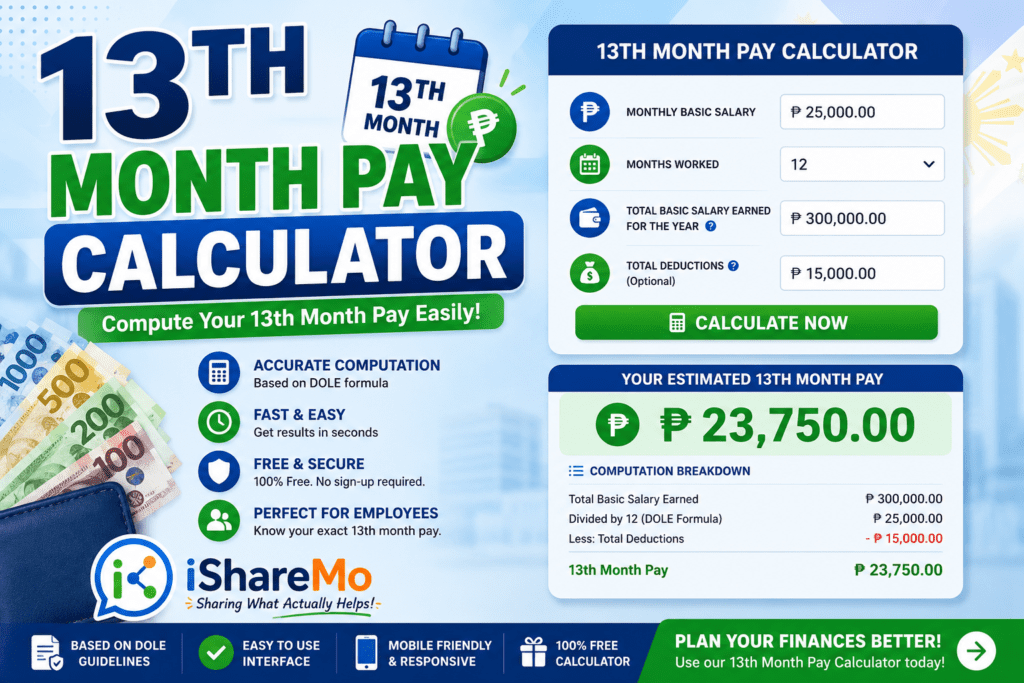
The basic formula for computing 13th month pay is:
Total basic salary earned during the year ÷ 12
Only basic salary is generally included in the computation.
This usually excludes:
Overtime pay
Night differential
Holiday pay
Allowances
Bonuses
Commissions (unless integrated into salary structure)
For example:
If an employee earned:
₱240,000 total basic salary for the year
The estimated 13th month pay would be:
₱240,000 ÷ 12 = ₱20,000
Employees who worked only part of the year receive proportional computation based on actual salary earned.
Why Financial Discipline Matters More Than the Amount
Some workers receive larger 13th month pay amounts than others, but long-term financial stability still depends heavily on spending habits and budgeting discipline.
Even modest 13th month pay can become valuable when used carefully for:
Savings
Debt reduction
Emergency preparation
Essential needs
Financial discipline matters more than temporary spending excitement.
Small smart decisions often create stronger long-term financial improvements compared to impulsive purchases.
Conclusion
Understanding 13th month pay Philippines rules helps employees better protect their rights and manage this yearly benefit more responsibly. Qualified rank-and-file employees are generally entitled to receive 13th month pay based on total basic salary earned during the year.
While the additional income provides financial relief during the holiday season, proper budgeting and financial planning remain extremely important.
Using 13th month pay wisely for savings, debt management, and essential expenses can help improve financial stability beyond the holidays.
FAQs about 13th Month Pay
Who qualifies for 13th month pay in the Philippines?
Most rank-and-file employees in the private sector qualify if they worked at least one month during the year.
Is 13th month pay mandatory?
Yes. Qualified employers are legally required to provide 13th month pay to eligible workers.
How is 13th month pay computed?
It is generally computed by dividing the employee’s total annual basic salary by 12.
Can resigned employees still receive 13th month pay?
Yes. Resigned employees may still receive proportional 13th month pay based on months worked.
Are bonuses different from 13th month pay?
Yes. Bonuses are usually discretionary while 13th month pay is mandatory under labor law.
When should employers release 13th month pay?
Employers are generally required to release it on or before December 24 each year.