How to Compute Your 13th Month Pay in the Philippines (Complete Guide)

Home » Government and Requirements » How to Compute Your 13th Month Pay in the Philippines (Complete Guide)

Many employees in the Philippines look forward to receiving their 13th month pay every year, especially during the holiday season. However, not everyone fully understands how it is computed, especially for employees who resigned, started late, or had salary changes during the year.

In this guide, you’ll learn how to compute your 13th month pay using the standard DOLE formula. We’ll also explain prorated computation, deductions, and important rules employees should know.

Quick Summary

Computing a 13th month pay is based on the total basic salary earned within the calendar year divided by 12. Employees who worked for only part of the year may still receive a prorated 13th month pay depending on their total basic salary earned. Overtime, allowances, holiday pay, and bonuses are usually not included in the computation. In this guide, you’ll learn the official formula, examples, and how to estimate your 13th month pay faster using an online calculator.

Table of Contents

See also  How to Get Pag-IBIG Number Philippines (Step-by-Step Guide)

What Is 13th Month Pay?

The 13th month pay is a mandatory monetary benefit given to rank-and-file employees in the Philippines.

Under Philippine labor laws, employers are generally required to provide 13th month pay to qualified employees not later than December 24 each year.

This benefit helps employees during the holiday season and serves as additional financial support.

Who Is Entitled to 13th Month Pay?

Most rank-and-file employees in the private sector are entitled to receive 13th month pay.

This usually includes employees who:

  • Worked for at least one month during the calendar year
  • Receive a monthly basic salary
  • Are employed in the private sector

Even resigned or separated employees may still receive a prorated 13th month pay based on the months they worked.

What Is Included in the Computation?

The computation is mainly based on the employee’s basic salary earned during the calendar year.

Basic salary generally includes:

  • Fixed monthly salary
  • Guaranteed wage payments

However, the following are usually excluded:

  • Overtime pay
  • Night differential
  • Holiday pay
  • Allowances
  • Bonuses
  • Commissions
  • Cash incentives

The actual company policy may vary depending on employment agreements.

Official Formula on How to Compute 13th Month Pay

The standard formula is simple:

Total Basic Salary Earned During the Year ÷ 12

This means the total basic salary earned from January to December is divided by 12 months.

Example Computation

Example 1: Full-Year Employee

If your monthly basic salary is ₱20,000 and you worked for the entire year:

₱20,000 × 12 = ₱240,000 total basic salary earned

₱240,000 ÷ 12 = ₱20,000

Estimated 13th month pay: ₱20,000

How to Compute Prorated 13th Month Pay

Employees who did not complete the full calendar year may still receive a prorated 13th month pay.

Example 2: Employee Worked for 6 Months

Monthly salary: ₱18,000

See also  How to Compute Your SSS Contribution in the Philippines (2026 Guide)

Months worked: 6 months

₱18,000 × 6 = ₱108,000

₱108,000 ÷ 12 = ₱9,000

Estimated prorated 13th month pay: ₱9,000

What Happens if Your Salary Changed?

If your salary changed during the year, the employer normally computes the actual total basic salary earned.

Example:

  • January to June: ₱18,000
  • July to December: ₱22,000

The employer adds the total earned salary first before dividing by 12.

This is why some employees receive higher or lower 13th month pay amounts than expected.

Are Deductions Allowed?

Some deductions may affect the total basic salary used in computation.

This can include:

  • Unpaid absences
  • Leave without pay
  • Salary adjustments

However, mandatory deductions like SSS, PhilHealth, and Pag-IBIG usually do not directly reduce the computation basis of basic salary.

When Is 13th Month Pay Released?

Employers are generally required to release the 13th month pay not later than December 24.

Some companies release it earlier depending on payroll schedules and company policy.

Others may split the payment into multiple releases during the year.

Common Mistakes Employees Make

Many employees incorrectly include overtime pay, allowances, and bonuses in their expected computation.

Others forget that:

  • Only basic salary is usually included
  • Resigned employees may still receive prorated pay
  • Salary changes affect the final amount
  • Unpaid absences may lower the total computation

Understanding these rules helps avoid confusion and incorrect expectations.

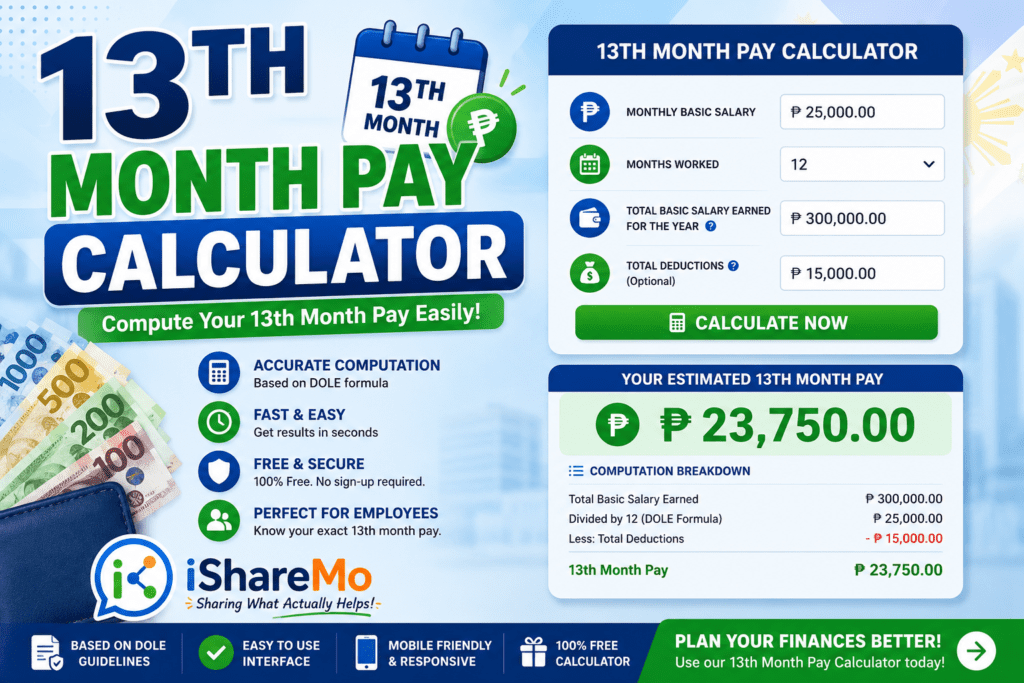
Use Our Free 13th Month Pay Calculator

Manually computing your 13th month pay can become confusing, especially if your salary changed or you worked only part of the year.

To make things easier, you can use our free calculator here: 13th Month Pay Calculator Philippines

13th Month Pay Calculator Philippines

The calculator helps estimate:

  • Full-year 13th month pay
  • Prorated 13th month pay
  • Salary-based computation
  • Deduction adjustments
  • Total estimated payout

FAQs

Are resigned employees entitled to 13th month pay?

Yes. Employees who resigned may still receive prorated 13th month pay based on months worked.

Is overtime included in 13th month pay?

Usually no. Overtime pay is generally excluded because only basic salary is commonly used.

Are allowances included in the computation?

Most allowances are not included unless stated in company policy.

When should employers release 13th month pay?

Employers are generally required to release it not later than December 24.

Can companies split the release of 13th month pay?

Yes. Some companies split payments during the year depending on company policy.

Is 13th month pay taxable?

13th month pay may be tax-exempt up to the government-approved threshold.

Conclusion

Learning how to compute your 13th month pay helps you better understand your expected benefits and avoid payroll confusion. Since the computation mainly depends on total basic salary earned during the calendar year, employees should track salary changes, unpaid absences, and months worked carefully.

Instead of manually computing everything, you can simplify the process using an online calculator. This helps estimate your 13th month pay faster and more accurately.